
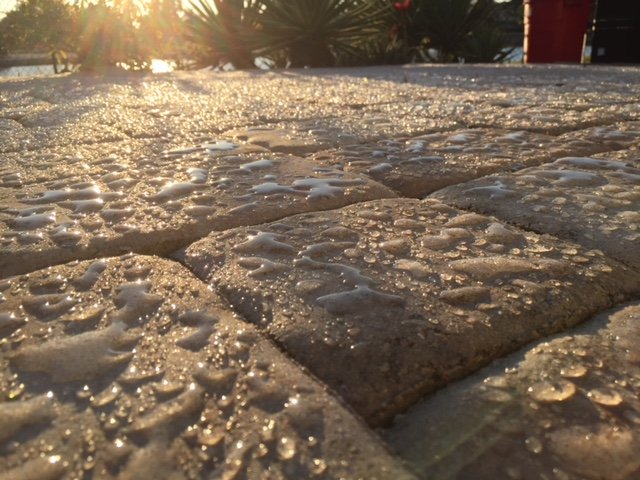
The product is rarely what ruins a Florida seal job. Timing is.
The question that comes up as often as “which sealer” is “can I seal it today?” Sometimes the honest answer is no.
After cleaning: plan on a dry day, not a dry look
Sealer should go down on a clean, dry surface.
A freshly cleaned paver can look dry on top and still hold moisture inside the material, in the joints, or in the setting bed. If you seal too soon, that moisture can get trapped. The finish may haze, blush, or fail to bond.
A reliable way to build a job is to clean and prep one day, then seal the next, weather permitting. That extra day is not padding the schedule. It is how the surface gets a real chance to dry in this humidity. Some water-based systems can be applied to a slightly damp surface, according to product literature, but pushing that in this climate is a risk. If the surface is puddling, dark with moisture, or still wet in the joints, wait.
Prep is a full step, not a quick rinse before you roll. Clean thoroughly, treat stains or efflorescence when needed, and re-sand only if the joints have washed out. Use a clean joint sand that meets industry standards, such as ASTM C33 or ASTM C144—not polymeric sand, which can trap moisture in the joints.
After rain: let the substrate dry, not just the top
Rain soaks the joints and, on many installations, the base—not just the top of the pavers. Do not seal over puddles or a surface that is still holding water. After a significant rain, give the job the same respect you would after a cleaning day. The top may dry in the sun faster than the material underneath, especially in shade, over a slab, or where drainage is poor. If weather interrupts a two-day job, reset the clock.
Watch the heat as closely as the moisture
In summer, it may also be necessary to wait for the surface to cool. Flash drying happens when sealer skins over too quickly because of high heat, a hot substrate, or direct sun. The product does not get time to penetrate and bond the way it should. That can leave roller marks, uneven sheen, haze, whitening, bubbles, streaks, or a coating that wears early. In bad cases, the job has to be stripped and redone. Pavers and concrete run hotter than the air, especially dark colors in full sun.
Check the surface, not just the forecast. Many applicators use early mornings, shaded sections, or cloud cover in the hotter months. As a field guideline, be cautious when the air is getting up around 95 degrees, or when the surface is in the 105 to 110 degree range or higher. Confirm the official application window on the current technical data sheet for the product in the sprayer, and when in doubt, wait until the next morning.
New pavers need time to cure
New work is a different kind of wait. After pavers are installed, they keep releasing moisture as they cure. They may look ready in a few days, but they are often still drying from within.
A general rule of thumb is to wait at least six weeks after installation before sealing, and sometimes longer. In Southwest Florida, humidity and rain can stretch that window. Concrete pavers typically take longer to cure than clay or natural stone. Poor drainage, shade, and tight installations over a slab hold moisture longer.
If you seal too soon, you can trap moisture, cause blushing, or lock in efflorescence, and the sealer may not bond. If a builder or homeowner wants the pavers sealed “as soon as they are in,” explain the risk.
Simple checks, and how to talk timing
The surface should not be visibly wet or puddled, and the joints should not be holding water. Use a water test for the right question. On a surface that is supposed to be unsealed and ready, a small splash of water should absorb evenly rather than sit on top. On a previously sealed surface, beading can mean the old sealer is still doing its job—and that another coat should not go down automatically.
Set the schedule up front. A typical well-run job is one day for cleaning and prep, one day for sealing, and then time for the sealer to cure before heavy use. If an old film has to be stripped first, add another day for that work and the drying that follows.
For return-to-service, many crews plan on foot traffic after about 24 hours and vehicle traffic after about 48 hours, even if the surface feels dry sooner. Confirm those windows on the technical data sheet for the product being applied. Early morning work in summer, and more flexibility from late fall through winter, usually gives a better window. Water-based products also have a temperature floor, so check the data sheet if a cold snap is coming.
FAQ
Can I clean and seal on the same day if I start early?
That is not a reliable plan in Southwest Florida. The surface can look dry and still hold moisture. A next-day seal is the more dependable approach.
What if the customer needs the driveway back immediately?
Be clear about cure time before the job starts. Walking on it too soon, or parking on it before it is ready, can mark a job that was otherwise done right.
How do I explain an extra dry day to the customer?
Talk about trapped moisture and flash drying in plain language. An extra day of waiting is easier to accept than a hazy or peeling finish that has to be stripped and redone.
Have a timing or weather question this post did not cover? Send it in—it may become a future article.


Leave a Reply